As a closeted quantum physics nerd, I am moved by these kinds of discussions about the Universe. Learning (or trying to learn) about its origin, its evolution, its anomalies, and our theories about it can not only be fascinating, but gives me some perspective on my silly, little life. I watched this last night and was left ruminating on the cosmos.
Saturday, January 18, 2014

Monday, December 16, 2013
Brit Marling & Zal Batmanglij in Conversation with Michael Moore
Michael Moore talks to two of my new favorite filmmakers.
Monday, October 28, 2013
R.I.P. Lou Reed, Godfather and Poet of Rock and Roll

that I developed a personal connection with the depth in Reed's words. There are probably other lyrics in the history of recorded music that surpass the genius of those in "Candy Says." But I don't know of them. Rather, I haven't obsessed over them as I have Reed's lyrics in "Candy Says", particularly the lines "what do you think I'd see/if I could walk away from me?" and "I'm set free to find a new illusion" from "I'm Set Free". (Perspective is such a cornerstone of Reed's writing--the perspective of the young, the wild, the newly sober, the lost, the dying, the denizens of Max's Kansas City, CBGB's and Warhol's Factory, the working class of New York and Berlin...etc) So, it was with the "Velvet Underground" record that I accepted the words of Lou Reed into my heart.
To be continued...
"Between Thought and Expression Lies A Lifetime"
When you are young and trying to shape your own identity, you either take in whatever influences are readily available to you or you go and seek out the people from whom you eventually cobble together a version of the person you would like to be. I didn't have anybody in my life that I could model myself after as a kid because I couldn't relate to anybody I knew. Everybody was either physically and/or emotionally unavailable. So I haunted libraries and record stores (probably to the annoyance of the people who worked at these establishments--"Fuck! There she is again.") and found that the only people I could identify with were writers and musicians. So when I came across Lou Reed, somebody who was both steeped in literature, and rock n roll, the two things that sustained me as a young person, I decided that he would be the template against which I could fashion the kind of person I wanted to be. It sounds a bit preposterous I know because when some people listen to "Waiting for the Man" or "Heroin," and especially if the latter is the only song they know from his recorded output, they imagine a junkie writing about what it's like to be a junkie and "how could that be the kind of person a young person would want to learn anything from except how to drive a syringe into the right vein?" But I dare anybody to try to express an experience as intense as taking heroin in a seven minute rock song and get as close to the marrow as Reed did with just words and sonic textures. It's one thing to write about something and another to be able to encapsulate that thing so succinctly that the audience is able to feel the experience you have written about. It's like "dancing about architecture". Only hypnotists and artists of Reed's caliber are able to make that kind of transference possible. I tried to find out everything I could about Lou Reed's influences because I aspired to write like that and immediately bought a copy of Hubert Selby's "Last Exit To Brooklyn" from the local bookstore. To my dissatisfaction, I had just been admitted to college by the skin of my teeth and was dragging myself to classes I did not have much interest in. I dropped out not long after my first year as a Journalism major, but I remember reading "Last Exit To Brooklyn" in my first semester and being simultaneously traumatized and thrilled by it. Holy shit did it contain some heavy stuff! I would take that once-banned book with its picture of a nude woman on the cover to my classes like a badge of honor. "Yeah, if you only knew the kind of wretchedness and depravity contained within the pages of this book, you would not sit so close to me because I'm reading it!" I could see the parallels in Reed and Selby's work--what Reed must have mined from Selby's fierce disregard for literary conventions. Between dropping out and resuming my studies, I spent a year and a half reading voraciously (Delmore Schwartz's stories among them), observing the cast of characters who loitered the streets in the red light district where I worked, and working things out internally. Taking Reed as my example, I would return from figuring out what I wanted to do with my life and major in English Literature, even contemplating a transfer to Syracuse University before quickly discovering the campus was encompassed almost exclusively by nature and white people. I would complete my studies in San Francisco and move to New York City where two months before Lou Reed's passing, I would encounter him one afternoon on the sidewalk in midtown Manhattan and be too spineless to go over and tell him how much his words and his example enriched my life.
To be continued...
I always enjoyed reading or seeing clips of Lou Reed being interviewed by hapless journalists unprepared for the task of simply engaging in conversation with him. Reed's acerbic responses to interviewers who were too lazy to do their research on him made me giggle. I often thought, "They should have counted themselves lucky to be the object of his sharp-witted humor." It began to make sense to me after I read an article where he explained that he doesn't go into interviews with the intention of being difficult, but that if you have ever held a conversation with any self-respecting New Yorker, you'd understand the way he interacts with journalists. At its worst (where the bad interviewers are concerned) Reed's answers can be loaded with aggression, sarcasm, and/or dissolve into outright mockery of the journalist. But I've found, reading some of his more illuminating interviews recently (Neil Gaiman's interview and the 1992 Chicago Tribune interview in particular) that he could also let his guard down an inch (stop being "Lou Reed, the persona") and be the most intelligent and fascinating person to talk to. And having lived in New York for going on five years now, I can tell you that Lou Reed is absolutely right about the way New Yorkers talk to each other. You can get them to tell you anything you want to know, but first, you have to get in the ring with them. You gotta work for it, man. When I moved to New York from California, I gradually detected that overt difference in conversational tone between us mealy mouthed West Coast transplants and the unfiltered speech of the New York City natives, whose sentences are habitually punctuated by "fuckin'". When I discovered the music of the Velvets and Reed's solo work (I have more vivid, singular memories of listening to his albums than any other solo artist I can think of. Listening to "Transformer","Berlin," "Metal Machine Music," or "New York" still transports me back to very specific times in my life.), I also tried to learn more about the fecund artistic environment from which the Velvets incubated and sprang forth from. Coincidentally, there seemed to be a renewed interest or at least a resurgence of popularity for Pop Art around the same time that I began to dig deeper into the music. So I went to the Pop Art exhibits until they seemed repetitive and even defiantly sat through a screening of "Symphony of Sound (1967)," a film Andy Warhol made of The Velvet Underground practicing (by the time the film was over, there were about half a dozen people left in the theater including myself). I had romanticized the art and music scene of downtown New York in the 60's and 70's so much so that I didn't mind that the first paying job I ever held was in the seedy part of downtown San Francisco, where there were still pimps and hookers, crackheads, flophouses, homeless punks, and people who were generally just out of their goddamn minds, "'cause those were the characters Lou Reed wrote about!" I thought while cleaning the pee off of the carpet inside a thrift store dressing booth. And I can remember as clear as day as I sit here typing, the time this dude walked into the shop with short-cropped bleached blonde hair, black leather jacket and aviator glasses like Reed during his Rock and Roll Animal/Street Hassle period and for a second, in my head I thought, "Holy shit, that was Lou Reed," knowing full well that that was impossible.
To be continued.
Thursday, September 27, 2012
"Louie" Season Finale on FX tonight @ 10:30
It's not easy for television shows to gain momentum year after year, but this has been the best season of "Louie" so far. Besides the plethora of guest spots this season (Parker Posey's performance being the most interesting of them), we also saw a shift in the format of the show. Instead of easing viewers into the show's subject or tone with stand-up bits like the first two seasons, sometimes we are thrown right into it (as in Season 3, Ep. 5: "Barney/Never" which begins in black and white, no less) and left to figure out what's happening. It probably means Louis C.K. has become a more confident director/producer, but it also means he can write the hell out of an episode and he doesn't have to rely on the usual structural elements that have worked before in the previous seasons in crafting future episodes. Tonally, this season could be described as having a bit more of a serious edge to it than the first two, but I don't think the producers of the show are interested in making what could easily be hammered into a one-dimensional sitcom--here's a middle-aged stand-up comedian who is also a divorced single-parent with two daughters who tries his hand at dating while trying to be a good father--add an annoying neighbor and cue the laugh-track. Because what makes "Louie" funny does not even have that much to do with any contrived situations that Louie finds himself in as the protagonist, which is what most sitcoms are based on. What makes the show funny is the understanding that despite the unfunny shit that happens to us (the serious, mundane adult stuff), there is still something funny to be derived from our pathetic, ironic, cowardly, childish, knee-jerk , or just plain dumb reactions to them (ex. S3 Ep 7- Louie's dread of visiting his father.) Some people call it black comedy, but that describes about 75% of real life. Okay, maybe just my life.

Louis C.K. wins two Emmy's. Aids!
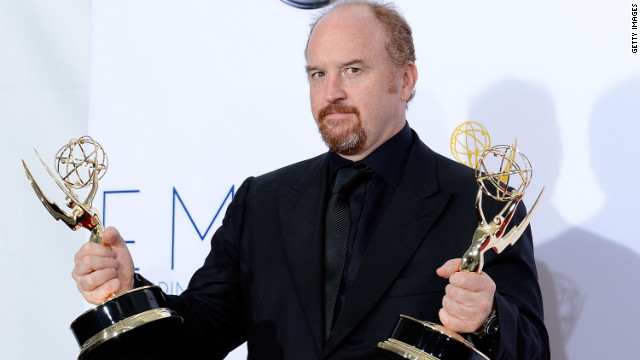
Louis C.K. wins two Emmy's. Aids!
Thursday, July 12, 2012
Wednesday, April 4, 2012
"This Must Be the Place" trailer
I checked the date on the article that this video was embedded into just in case I was late to the party on an elaborate online April Fools joke. Nope, it's dated today. This is an actual movie that will be released that people will pay to see just so they can laugh at Sean Penn's portrayal of a pathetic-looking goth dude on a mission--wait for it--to find the Nazi war criminal who had his father executed at a concentration camp. The sleeper hit of 2012?*
*sarcasm
Monday, March 19, 2012
"Björk’s Big Bang," New York Magazine profile by Nitsuh Abebe
I think our projected image of Bjork as this Icelandic snow princess--an image which, to be fair, she has not done much to repudiate--is so entrenched, that at this point, any profile of the artist which does not depict her as a sort of ethereal, pixie-like ambassador-of-the-arts-dispatched-from-the-celestial-heavens-to-expand-our-ideas-of-music-and-nature, is not a very accurate one. It is as though to not mention that she wears oufits most people would consider bizarre would be the equivalent of omitting a characteristic, facial feature from a portrait painting-such as the hollow of one's dimples, or a crease between the eyebrows, thereby throwing off the entire likeness of the person being painted. Abebe seems aware of this, judging by his humorous observations, but he manages to center his profile on a portrait of an artist who is first and foremost, a "rigorous, conceptual thinker."
Björk’s Big Bang
Bjork - "Hollow" music video
Björk’s Big Bang
Bjork - "Hollow" music video
Friday, October 14, 2011
The Walking Dead Season 2 Premieres October 16 9PM on AMC
Edit: The Walking Dead, Season 2 will be helmed by Glen Mazzara, assistant to the show's former showrunner, writer and executive producer, Frank Darabont, who was fired in August. According to various sources, it sounds like Darabont was unwilling to implement the major budget cuts AMC demanded in the wake of the network's contract negotiations with Matt Weiner of Mad Men--their first original hit series. The way Kurt Sutter--FX's Sons of Anarchy showrunner--put it, it seems like AMC was stealing from Peter to pay Paul and Darabont was having none of it.
Is that really a viable business strategy for a network that is striving to build on its success anyway? It seems like such a counterintuitive approach to developing a solid roster of original shows by putting all the chips on one asset even if it is the safest bet. But I guess that's Hollywood.
From The Hollywood Reporter: "What remains a central mystery, even to those closely involved, is what triggered AMC's move to fire Darabont. As noted, AMC's decision to cut the budget dated to the previous fall, when the network instructed Darabont to produce 13 episodes for a second season, up from six for the first season, for less money. Not only would the show get a lower budget, but AMC also decided that Walking Dead would no longer reap the benefit of a 30 percent tax credit per episode that came with filming in Georgia. Now the network was going to hold on to that money."
According to Kurt Sutter via Twitter, [Matt Weiner, the creator, head writer and showrunner of Mad Men] held AMC hostage, broke their bank, budgets were slashed, shit rolled down hill onto [Vince]gilligan and frank,"... "no one else wants to f*cking say it, but the greed of mad men is killing the other two best shows on tv -- breaking bad and walking dead."
"darabont reacted strongly to slashed budgets. he made mistakes, he was fired. no creative in town will trust AMC to back up their artists,"..."i don't know MW, got no beef with him. just hate that darabont is being demonized. no one has the balls to tell the truth. MM gutted AMC." Quotes taken from The Huffington Post
Maureen Dowd's column on Steve Jobs
It is virtually impossible to think that a Steve Jobs biopic is not in development somewhere. What an extraordinary life. I think that because we ( myself included) take the technology that goes into iPods, iPads, and iPhones for granted now (by that I mean the "shock of the new" from the unveiling of the first generation of iPods, iPads and iPhones seems to have dissipated and I think we expect there to be better, faster, cooler versions every year now), we forget that the whole concept of making vast libraries of streamlined information portable was pioneered by Steve Jobs and co. at Apple. R.I.P. Mr. Jobs.
Saturday, October 1, 2011
Toronto Film Festival 2011: "Take This Waltz" Q&A
I've been a fan of Sarah Polley's since seeing her in Atom Egoyan's "The Sweet Hereafter" and Isabelle Coixet's "My Life Without Me." She directed "Away From Her" in 2006, which depicted the final stages of a marriage as Julie Christie's character succumbs to Alzheimer's disease. "Take This Waltz" will be her second feature and if the teaser trailers are any indication, it will be very good.
"Take This Waltz" was shot on digital and it looks great. It's interesting that digital cinematography has advanced so much in the past five years alone that it has become harder and harder to distinguish which movies were shot on film and which were shot in HD. And when you see how beautiful and vivid films that are captured digitally can be, (David Fincher's upcoming, "Girl With the Dragon Tattoo," is one example), it becomes less important what format filmmakers decide to use.
http://vimeo.com/28912284 from Tim Shore on Vimeo.
The Globe and Mail's interview with Sarah Polley on "Take This Waltz"
Saturday, September 10, 2011

Thursday, September 8, 2011
J.J. Abrams & Jonah Nolan's "Person of Interest" Series Premiere
September 22 on CBS at 9 PM
I'm only watching this to see if Ben succeeds in bringing everyone back to the island.
I'm only watching this to see if Ben succeeds in bringing everyone back to the island.
Tuesday, September 6, 2011
New Album from Tom Waits Out in October
via Pitchfork
It's called, "Bad As Me" and Waits debuts it in an unconventional setting to listeners after he finds out something we've all lived with since the internet was invented--there is no such thing as privacy anymore.
It's called, "Bad As Me" and Waits debuts it in an unconventional setting to listeners after he finds out something we've all lived with since the internet was invented--there is no such thing as privacy anymore.
Tuesday, August 30, 2011
Soft Focus Season 3: Jennifer Herrema (Royal Trux, RTX)
I love this VBS series. Ian Svenonius (Nation of Ulysses) has interviewed so many interesting people on it. Jennifer Herrema, singer for Pussy Galore, Royal Trux, and RTX, was one of those interviewed. Cool shit.
Saturday, August 27, 2011
San Francisco Film Society Exec. Director, Graham Leggat, Passes Away at 51

I am subscribed to tons of mailing lists--lists that I've never even heard of or read, that some third-party affiliate has obtained my information for. I don't read most of my e-mail because so much of it is junk. But this morning I opened an e-mail sent from the San Francisco Film Society to film society members past and current, that said Graham Leggat, the executive director of the SF Film Society had died of cancer on Thursday. That news affected me more than I thought it would because I never knew Mr. Leggat. Yet his work spearheading the Film Society probably played a huge part in my film education.
Film Society screenings at the Castro, the Moma, and the Pacific Film Archives were my film school. As executive director of the Film Society, Leggat was responsible for all of the festivals that ran in the city throughout the year from 2005 to 2011--the Silent Film Festival, San Francisco's annual International Film Festival, the Frameline Film Festival, the Asian Film Festival...(I'm sure I'm missing a bunch more) and I went to many of them. I took notes. I dissected those films, I devoured them. When I think about when my real cinematic education began--by this, I mean my education AT the cinema, watching and studying movies projected in a theatre--it seems to coincide around the time Leggat was appointed executive director of the SF Film Society. And this is important, to me at least, because it demonstrates what Leggat was instrumental in achieving during his six years at the Film Society. He made the organization visible. It didn't seem like there was a film culture in San Francisco six years ago. Not to younger people anyway. Then all of a sudden, people like me cared about and knew when film society screenings were happening. They revamped their website, published a monthly newsletter (which I still receive and read even though I live in New York now), got top-notch filmmakers and actors like George Lucas, Spike Lee, Gena Rowlands, Werner Herzog and Gus Van Sant to speak at festival events. Currently, they distribute grants and provide resources to filmmakers to foster the city's homegrown talent. San Francisco as a shooting location doesn't seem like L.A. or New York's cool but ugly, cousin anymore. These aren't the singular achievements of one person, but Leggat had a hand in overseeing all of it. His passing is like the passing of a dean of a school at a university. The school of cinema, perhaps. I didn't know him, but he was responsible for the curriculum I was taught and I appreciate the education I received. R.I.P. Graham Leggat.
Monday, August 1, 2011
Iggy Pop: New Values (1979) album cover
I can count the number of times that I have been in a record store this year on one hand. Now, when I'm listening to a track on my computer or on my phone, I have this compulsive desire to hold a physical copy of whatever I'm listening to in my hands; to dissect the album artwork and skim the liner notes. But I hardly ever get a chance to look at the artwork that accompanies the music I listen to anymore, which is a shame. It makes me all the more grateful for the time I spent at record stores in my teens when the artwork on a cover was often an indicator of whether the music was any good.

This is the cover of Iggy Pop's 1979 album, "New Values". The image is provocative on several levels, but mainly for its reference to S&M. It is theatrical--Are they in a play? Are they doing performance art? Is that a spotlight in the background?--with a hint of violence. What are those ballerinas going to do with him? Are they performing some sort kind of satanic rite? In leotards? It's a bit like Iggy Pop meets Suspiria.

This is the cover of Iggy Pop's 1979 album, "New Values". The image is provocative on several levels, but mainly for its reference to S&M. It is theatrical--Are they in a play? Are they doing performance art? Is that a spotlight in the background?--with a hint of violence. What are those ballerinas going to do with him? Are they performing some sort kind of satanic rite? In leotards? It's a bit like Iggy Pop meets Suspiria.
Saturday, July 30, 2011
"Alexander McQueen: Savage Beauty" retrospective at The Met
via The New York Times online

"THERE was a reason Alexander McQueen, who committed suicide last year at the age of 40, was considered one of the greatest fashion designers of his generation, admired by his peers for his astounding technical ability and idolized by students for his near-fearless risk taking. “People don’t want to see clothes,” he once said. “They want to see something that fuels the imagination.”

But while he was revered in fashion, and his runway shows were among the most closely watched, almost no one could have imagined that, as the subject of a museum exhibition, Mr. McQueen would prove to be almost as popular as Pablo Picasso and Vincent van Gogh." Full article here.
The exhibition closes on August 7, but The Met will remain open until midnight on August 6 & 7 for the first time in its history.

"THERE was a reason Alexander McQueen, who committed suicide last year at the age of 40, was considered one of the greatest fashion designers of his generation, admired by his peers for his astounding technical ability and idolized by students for his near-fearless risk taking. “People don’t want to see clothes,” he once said. “They want to see something that fuels the imagination.”

But while he was revered in fashion, and his runway shows were among the most closely watched, almost no one could have imagined that, as the subject of a museum exhibition, Mr. McQueen would prove to be almost as popular as Pablo Picasso and Vincent van Gogh." Full article here.
The exhibition closes on August 7, but The Met will remain open until midnight on August 6 & 7 for the first time in its history.
Saturday, July 9, 2011
Video: Radiohead (The King of Limbs) Live from The Basement
Videos arranged in order of songs played. Setlist via Consequence of Sound.
Radiohead Live from The Basement: The King of Limbs (Part 2)
Radiohead Live from The Basement: In Rainbows 2010
Radiohead Live from The Basement: The King of Limbs (Part 2)
Radiohead Live from The Basement: In Rainbows 2010
Tuesday, June 28, 2011
Kevin Smith's Game-Changing Distribution Model
I consider myself a Kevin Smith fan. I've seen most of his films. I've seen the spoken word DVDs. I listened to the early sModcasts. I check in intermittently with what's going on in the Askewniverse. And although I haven't enjoyed all of his output, I am glad he is still generating it with the same spirit and humor with which he made Clerks, Chasing Amy, Dogma, etc. The world of indie filmmaking needs somebody like Kevin Smith. This was never more apparent to me than when I saw the video of Smith's speech at the Sundance Film Festival this year. In the speech, he presented a new film distribution model which he said he was going to use to market his most recent movie, Red State. He pointed out the single most glaring obstruction in the way independent movies are currently distributed--you scrounge up enough money to make the film for $500,000 or whatever the cost may be, get it in the can, and still have to surmount the marketing barrier that keeps your film from being seen by an audience. And in exchange for safe passage over this formidable wall, traditionally, you had to throw money at it. Smith challenged this notion and sent reverberations throughout the indie and Hollywood circuits. One unfortunate "journalist" went so far as to characterize Smith's speech as a nervous breakdown, a career-ending "implosion." Other commentators said he basically burned every bridge he had left.
Did they listen to the same speech I did? Dude essentially drew a line (with Wayne Gretsky's hockey stick in hand) between the traditional film distribution model which was heavily reliant on old media (ie. No tv ads and no print ads = no audience for your movie) and a new model based on self-distribution through social media and added value screenings. It is very similar to what independent and established musicians are doing now that the record industry is dying a slow death. I thought it was a bold and inspirational declaration. He announced a tour of his film throughout the U.S., with each screening to be followed by a Q&A, which would make back the money his investors had put in the movie. And according to a recent "Red Statement," it did.
After seeing that video of Smith's speech, I have been thinking about what this paradigm shift will mean for current and future filmmakers. I haven't been able to draw any clear conclusions yet except that in order for Smith's type of business model to work, filmmakers will have to initiate and maintain a direct line of communication with their audience (typically through social media these days), and they will have to form relationships with exhibitors (ie. theaters) which will enable them to present their films in ways that will translate into new and exciting experiences for audiences. How these new distribution models (and I suspect there will be many more new and diverse ones) will affect the types of movies that we buy tickets to see however, is a fascinating mystery. At this point, the frontiers are wide open.
Read about Kevin Smith's self-distribution venture here from the man himself.
Video of Smith's Sundance 2011 speech below.
Subscribe to:
Posts (Atom)